


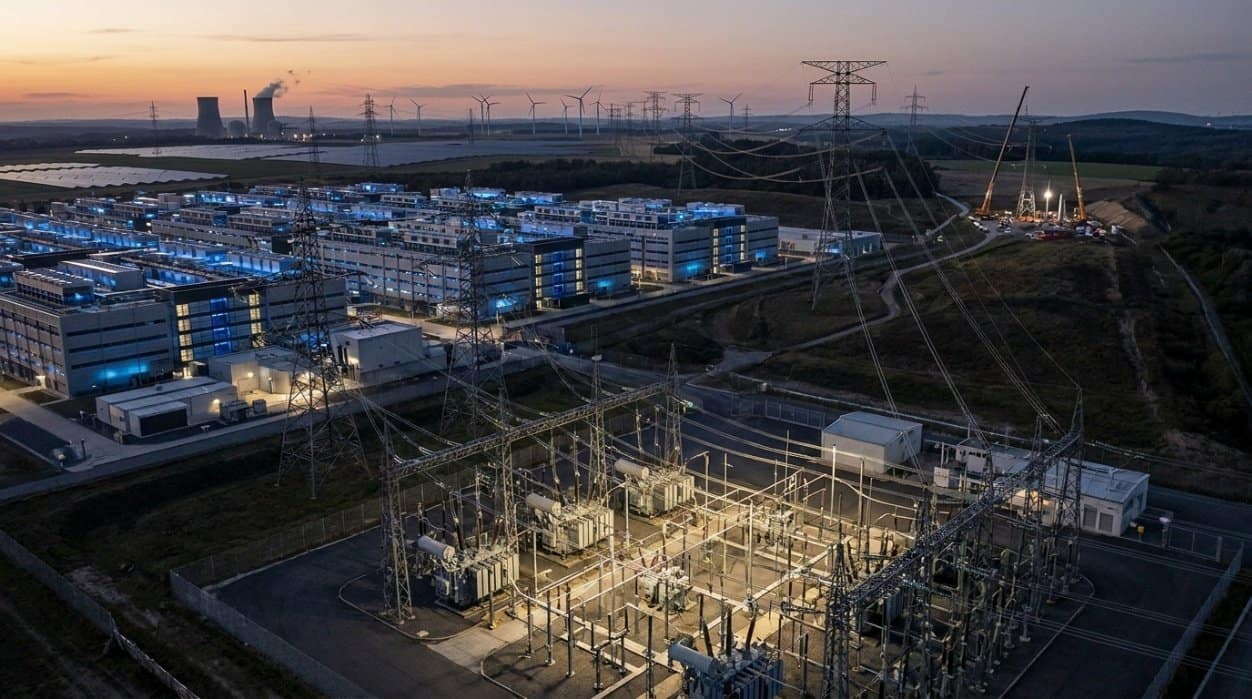
AI Power Grid Crisis 2026: Why Grid Capacity Matters
Artificial intelligence has spent the past several years racing against one obvious constraint: computing power.
Technology companies needed more advanced chips, larger data centers and billions of dollars to build increasingly capable AI systems.
But in 2026, another constraint is becoming impossible to ignore.
Electricity.
AI companies can order processors.
Investors can finance new data centers.
Developers can acquire land.
But none of those assets matter if the electricity grid cannot supply enough reliable power where and when it is needed.
That is turning the AI power grid crisis into one of the most important infrastructure problems of the technology boom.
The International Energy Agency projects that global data-center electricity consumption could more than double to around 945 terawatt-hours by 2030. From 2024 through 2030, data-center electricity consumption is expected to grow around 15% annually—more than four times faster than electricity consumption across other sectors.
The pressure is already visible.
In Europe, new hyperscale data centers are moving much farther from major cities as developers search for available power, cheaper land and faster grid connections. In the United States, transmission congestion is contributing to higher wholesale electricity costs. Meanwhile, countries including China are sometimes producing renewable electricity that their grids cannot fully absorb.
The strange reality of the AI boom is becoming clear:
The world may have enough electricity generation potential, yet still struggle to deliver enough electricity to the places where AI needs it.
And that could change where the next generation of AI infrastructure gets built.
AI Has Become a Physical Infrastructure Business
Artificial intelligence appears digital.
Users open an application, enter a prompt and receive an answer almost instantly.
Behind that simple interaction sits an enormous physical system.
Modern AI requires advanced processors, high-bandwidth memory, networking equipment, cooling systems, backup power and massive data-center campuses operating around the clock.
Those facilities require extraordinary amounts of electricity.
Some of the largest U.S. data-center developments can require more than one gigawatt of continuous power, according to Reuters—roughly enough to supply as many as 850,000 homes.
This changes the economics of artificial intelligence.
A conventional software company could historically expand by renting additional cloud capacity.
The largest AI systems now require infrastructure resembling industrial facilities.
Our previous analysis of the rise of AI factories explored how purpose-built computing campuses are becoming the factories of the digital economy.
But factories need power.
That means AI developers increasingly depend on industries that technology companies cannot control completely:
utilities,
electricity-grid operators,
power-plant developers,
transmission companies,
regulators,
construction firms,
and governments.
The AI race has therefore moved beyond Silicon Valley.
It is becoming an energy and infrastructure race.
1. Data Centers Are Moving to Where the Electricity Is
For years, data centers clustered around major technology and financial hubs.
London.
Frankfurt.
Amsterdam.
Dublin.
Northern Virginia.
These locations offered excellent fiber connectivity, large customer bases and established digital infrastructure.
But AI is beginning to change the calculation.
Power availability is becoming more important than proximity to major cities.
Recent European development provides striking evidence.
Data from real-estate firm JLL reported by Reuters shows that hyperscale data centers scheduled for construction between 2026 and 2028 will be located an average of around 175 kilometers from major urban centers.
For projects built between 2022 and 2025, the average was only about 46 kilometers.
That is an enormous shift in only a few years.
Developers are increasingly considering secondary cities and rural areas because traditional data-center hubs face shortages of land, grid capacity or both.
The economics can also be dramatically different.
Reuters reported that powered land could cost around €2.7 million per megawatt in Amsterdam compared with roughly €200,000 in Bordeaux.
This suggests the geography of the internet itself may be changing.
For many AI workloads, especially model training, a data center does not necessarily need to sit next to millions of users.
It needs reliable electricity.
As a result, regions previously considered peripheral could become valuable AI infrastructure hubs.
2. The Problem Is Not Simply Generating More Electricity
At first glance, the solution to rising AI demand appears obvious.
Build more power plants.
But electricity systems are more complicated.
Generating electricity is only one part of the system.
Power must travel from where it is produced to where it is consumed.
That requires:
high-voltage transmission lines,
substations,
transformers,
distribution infrastructure,
grid-control systems,
and connections capable of handling enormous new loads.
This is where one of the biggest bottlenecks is appearing.
The United States provides a striking example.
During the first half of 2026, transmission congestion costs across PJM—the largest U.S. electricity market—rose 43% to $6 billion, according to its independent market monitor.
Reuters reports that rising electricity demand from data centers, electric vehicles and heat pumps is contributing to pressure on the system.
The economic consequences eventually reach consumers.
When transmission lines become congested, electricity cannot always move efficiently from cheaper generators to areas where demand is highest.
More expensive generation may then be needed locally.
Wholesale electricity prices can rise even if the country technically has enough generation overall.
This is the heart of the AI power grid crisis.
The problem is increasingly not simply:
Can we produce enough electricity?
It is:
Can we deliver enough electricity to the right location at the right time?
3. The Renewable Energy Paradox
The grid problem creates another strange situation.
Some countries are simultaneously struggling to supply growing electricity demand while throwing away renewable electricity.
China illustrates the scale of the problem.
The country’s wind and solar capacity has expanded rapidly.
But its transmission network cannot always absorb or transport all of the electricity being produced.
China’s National Energy Administration said 8.6% of solar output and 9.1% of wind output were curtailed during the first half of 2026. Independent estimates cited by Reuters put total curtailment even higher.
Curtailment means electricity that could have been generated is deliberately not used because the grid cannot handle it.
Similar challenges are appearing elsewhere.
India is considering low-cost loans for renewable-energy developers whose projects have suffered losses because inadequate transmission infrastructure limited how much electricity they could supply.
This exposes a fundamental misunderstanding about the energy transition.
Building renewable generation is not enough.
Countries also need transmission.
Storage.
Grid modernization.
Flexible demand.
Better regional connections.
Otherwise, enormous quantities of clean electricity can exist without reaching the industries that need them.
AI makes solving this problem more urgent because data centers create large, concentrated electricity loads.
4. AI Could Turn Electricity Into a Technology Advantage
The global AI race is usually discussed in terms of chips and models.
Which country has the best researchers?
Who controls advanced semiconductor manufacturing?
Which company has the most powerful model?
Increasingly, another question matters:
Who has the electricity?
Countries capable of offering abundant, reliable and reasonably priced power could attract enormous AI investment.
France provides an interesting example.
Its large nuclear-power fleet gives the country access to substantial low-carbon electricity, potentially strengthening its position as a European data-center hub.
France exported a record electricity surplus last year, while major investors have announced enormous AI infrastructure plans in the country.
This creates a new form of technological competition.
Regions with cheap energy but historically limited technology industries may suddenly become attractive.
Countries with strong software ecosystems but constrained grids could find expansion more difficult.
The Light Span’s analysis of the AI infrastructure race already showed how computing capacity is becoming a strategic resource.
Electricity is now becoming part of the same equation.
The future AI leaderboard may therefore depend partly on national energy policy.
5. Why Building New Grid Infrastructure Takes So Long
Technology companies operate on extraordinarily fast timelines.
Electricity grids do not.
A new AI model can be developed in months.
A data-center campus can sometimes be constructed within a few years.
Major transmission lines can take much longer.
Projects often require:
route planning,
environmental reviews,
land acquisition,
community consultation,
regulatory approval,
financing,
equipment procurement,
and years of construction.
Transformers and other specialized electrical equipment can also face supply constraints.
This creates a mismatch.
AI demand is growing at technology speed.
Electricity infrastructure expands at infrastructure speed.
That difference is one reason the AI infrastructure spending boom is moving beyond chips and servers.
Technology companies increasingly need to think years ahead about energy.
A company cannot simply announce a giant data center and assume the local utility will immediately provide another gigawatt of electricity.
In some locations, power availability may determine the project schedule more than construction itself.
That could become increasingly important as AI investment continues accelerating.
6. Can Renewable Energy Power the AI Boom?
Renewables will almost certainly play a major role.
Solar and wind power can be built relatively quickly and increasingly provide low-cost electricity in many markets.
Technology companies have also signed enormous renewable-power agreements as they try to secure electricity while meeting climate commitments.
But AI data centers create a difficult requirement:
They operate continuously.
Solar generation disappears at night.
Wind generation changes with weather.
That means grids need ways to balance variable generation.
Solutions include battery storage, transmission between regions, flexible demand and complementary power sources.
This is why the AI energy debate cannot simply become a competition between renewables and fossil fuels.
The challenge is building a system capable of supplying reliable power every hour.
A large data center cannot simply stop operating whenever clouds reduce solar production.
AI therefore strengthens the case for combining different energy sources with storage and stronger grids.
The most competitive regions may be those capable of providing clean, affordable and dependable electricity simultaneously.
7. Nuclear Power Is Getting Another Look
AI’s electricity appetite has helped revive interest in nuclear power.
Nuclear plants have one particularly attractive characteristic for data centers:
They can provide large quantities of electricity continuously.
That makes nuclear generation potentially useful for industries requiring reliable 24-hour power.
Interest is also increasing in small modular reactors, or SMRs.
These are designed to be smaller and potentially easier to deploy than conventional large nuclear plants.
But expectations should remain realistic.
Commercial deployment remains limited, costs are uncertain and regulatory approval can take years. Reuters notes that significant hurdles remain even as SMRs attract growing attention in the U.S. electricity debate.
Nuclear therefore cannot solve an immediate grid shortage overnight.
But over a longer horizon, it could become one part of the energy mix supporting AI infrastructure.
This illustrates an important point.
The AI boom is beginning to influence investment decisions in industries that once seemed far removed from software.
8. Natural Gas May Remain Important
The pressure for reliable electricity also means natural gas could remain important longer than some energy-transition forecasts expected.
Gas plants can provide dispatchable electricity when renewable output is insufficient.
They can also be built closer to large electricity loads in some regions.
But there are complications.
Gas turbines themselves can face supply constraints.
Fuel prices can fluctuate.
New fossil-fuel infrastructure can conflict with climate goals.
Gas pipelines may also need expansion.
The result is unlikely to be one universal solution.
Different regions will use different combinations of:
renewables,
gas,
nuclear,
hydropower,
battery storage,
and grid expansion.
The winning strategy will probably depend on local resources.
9. Could AI Increase Electricity Prices for Everyone Else?
This is becoming one of the most politically sensitive questions.
Data centers can bring investment, tax revenue and construction activity.
But they also consume enormous amounts of electricity.
If new demand arrives faster than generation and transmission capacity, prices can increase.
PJM provides a warning.
Its independent market monitor says transmission constraints were the single biggest contributor to the increase in wholesale electricity costs during the first half of 2026.
Data centers are not the only reason.
Weather, electrification and other sources of demand also matter.
But rapid AI infrastructure development adds another large load to systems already requiring modernization.
Governments therefore face a difficult policy question:
Who should pay for grid upgrades required by giant data centers?
If utilities pass all costs to ordinary customers, political resistance could grow.
If technology companies are required to finance substantial infrastructure themselves, projects could become more expensive.
Finding a fair balance may become one of the biggest regulatory debates surrounding AI infrastructure.
10. The AI Boom Could Create Unexpected Winners
The grid bottleneck creates opportunities as well as problems.
For every company building AI models, another group of businesses may benefit from supplying the infrastructure.
Potential beneficiaries include:
utilities,
transformer manufacturers,
electrical-equipment companies,
grid software providers,
engineering firms,
battery developers,
nuclear companies,
renewable developers,
natural-gas infrastructure,
and transmission operators.
This broadens the economic impact of artificial intelligence.
The AI revolution is not confined to semiconductor companies.
It increasingly reaches construction, energy and heavy industry.
Our earlier article on AI data-center electricity demand explored why power consumption itself is becoming a major economic issue.
The next stage goes further.
The biggest opportunities may emerge from fixing the bottlenecks created by that demand.
Could the Power Grid Actually Slow the AI Boom?
Yes—but probably not stop it.
The more likely outcome is that electricity constraints change where, how quickly and at what cost AI infrastructure gets built.
Data centers may move farther from traditional technology hubs.
Companies may finance their own generation.
Nuclear plants could receive new investment.
Utilities may accelerate transmission construction.
Governments could streamline permitting.
Regions with abundant electricity may attract projects previously destined for major cities.
Technology companies may also improve the efficiency of AI hardware and models.
Efficiency matters because reducing the electricity required for each AI task allows more computing to be performed using the same infrastructure.
The AI industry therefore has two ways to address the problem:
produce more electricity,
or use existing electricity more efficiently.
It will probably need both.
What Happens Next?
The next several years could determine whether electricity becomes a temporary constraint or a structural limit on AI growth.
The IEA’s projection of roughly 945 TWh of global data-center electricity consumption by 2030 shows how quickly demand could increase.
But the critical number will not simply be total global generation.
Location matters.
Transmission matters.
Reliability matters.
Connection times matter.
A country could theoretically produce enormous amounts of electricity while still lacking capacity in the region where a data-center developer wants to build.
That is why grid investment may become as strategically important to AI as semiconductor investment.
The next AI race could be won partly by electrical engineers.
FAQs
Why does AI use so much electricity?
Advanced AI requires thousands of specialized processors operating simultaneously. Electricity is needed both to run those processors and to cool the data centers containing them.
How much electricity will data centers use?
The International Energy Agency projects global data-center electricity consumption could reach around 945 TWh by 2030, more than double current levels.
Why can’t countries simply build more renewable energy?
Generation alone does not solve the problem. Electricity must be transmitted to where it is needed, and inadequate grid capacity can force renewable electricity to be curtailed.
Are data centers moving because of electricity shortages?
Power availability is increasingly influencing location decisions. European hyperscale projects planned for 2026–28 are being built substantially farther from major urban centers than projects developed during 2022–25.
Can nuclear power solve AI’s electricity problem?
Nuclear power could contribute because it provides continuous electricity, but new reactors require significant investment and long development timelines. Small modular reactors remain promising but commercially immature.
Will AI make household electricity more expensive?
It could contribute to higher costs in regions where demand grows faster than generation and transmission capacity. The outcome depends heavily on local grid investment and how infrastructure costs are allocated.
The Light Span Perspective
The AI power grid crisis reveals something fundamental about the next phase of artificial intelligence.
The biggest constraints may no longer come from software.
They may come from the physical world.
AI requires processors, but processors require data centers. Data centers require electricity. Electricity requires power plants, transmission lines, transformers and regulatory approval.
Each layer introduces another potential bottleneck.
That could reshape the global AI race.
Countries with excellent researchers but weak electricity infrastructure may struggle to expand computing capacity. Regions with abundant, reliable energy could attract billions of dollars in investment even if they were previously outside major technology hubs.
The solution is also bigger than simply building more power plants.
Modernizing grids, expanding transmission, increasing storage and improving computing efficiency will all matter.
Artificial intelligence is often described as a digital revolution.
But its next chapter may be surprisingly industrial.
The countries and companies that solve the electricity challenge will not merely keep the lights on inside data centers.
They could determine where the infrastructure of the AI economy is ultimately built.
Continue reading more
https://www.iea.org/reports/energy-and-ai/energy-demand-from-ai

