


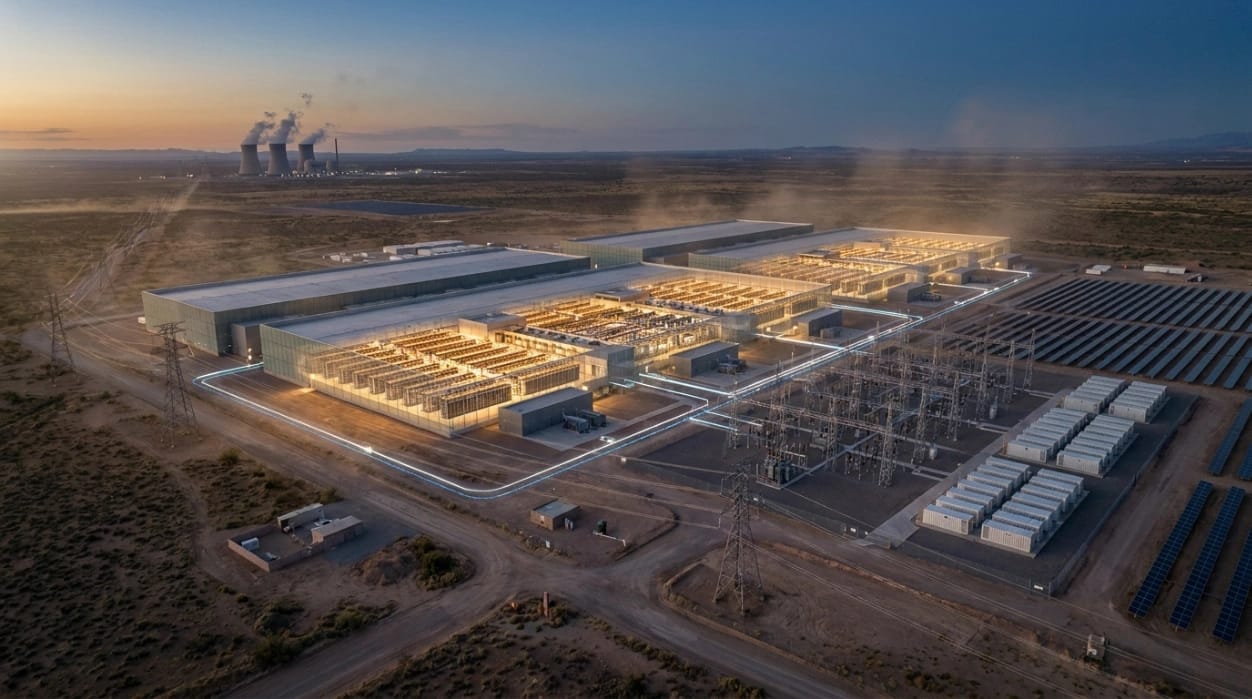
AI Data Center Power Demand: Why Electricity Needs Are Rising
Artificial intelligence has spent the last several years competing for better chips.
The next phase of the race may be about something even more basic:
electricity.
On August 18, OpenAI announced that it had entered an agreement to secure approximately 8 gigawatts of IT capacity at the PORTS-Pike Technology Campus in Pike County, Ohio.
The project involves SB Energy, NVIDIA and the U.S. Department of Energy, and OpenAI says it will pay the energy and infrastructure costs specifically associated with its development.
Eight gigawatts is an extraordinary number for a computing project.
But it also represents something much bigger.
Artificial intelligence is no longer developing primarily as a software industry.
It is becoming a heavy infrastructure industry.
Frontier AI requires semiconductor factories, enormous computing clusters, high-speed networks, cooling systems, substations, transmission lines and huge amounts of reliable electricity.
The biggest technology companies are consequently beginning to behave differently.
They are not simply buying servers.
They are securing power.
They are investing in energy projects.
They are choosing locations based partly on grid capacity.
And increasingly, they are building computing campuses whose energy requirements would have sounded extraordinary only a few years ago.
This creates one of the most important questions surrounding the AI boom:
Can electricity infrastructure expand quickly enough to support it?
The answer could influence where AI data centers are built, how expensive AI becomes, which countries lead the industry and even what ordinary households eventually pay for electricity.
Here are seven signs that AI data center power demand is becoming one of the defining infrastructure challenges of the AI era.
1. AI Campuses Are Moving Into the Gigawatt Era
For perspective, traditional data centers were not usually discussed in terms of multiple gigawatts.
The rapid development of frontier AI is changing that.
Training and operating increasingly sophisticated AI systems requires enormous clusters of specialized accelerators.
Those processors need electricity continuously.
They also generate tremendous amounts of heat, meaning additional energy is required for cooling and supporting infrastructure.
OpenAI’s latest Ohio agreement illustrates the scale toward which the industry is moving.
The company says it has secured approximately 8 gigawatts-IT at PORTS-Pike, a technology campus being developed on the site of the former Portsmouth Gaseous Diffusion Plant.
OpenAI’s PORTS-Pike announcement
That does not mean an 8-GW computing complex suddenly switches on tomorrow.
Projects of this scale are developed over years, and planned capacity is different from operational consumption.
But the ambition itself matters.
AI companies increasingly believe future computing requirements will be so large that infrastructure must be planned on a scale previously associated more closely with heavy industry than software.
This follows the broader infrastructure race already underway.
OpenAI previously announced additional Stargate sites that together were expected to push planned capacity beyond 5 gigawatts, while other technology companies have been expanding data-center construction globally.
The unit of measurement for frontier AI infrastructure is changing.
Megawatts are increasingly giving way to gigawatts.
And that changes almost everything about where these facilities can be built.
2. Electricity Is Becoming as Important as AI Chips
For much of the AI boom, one company sat at the center of the infrastructure story: NVIDIA.
Demand for advanced GPUs became so intense that access to computing chips effectively determined how quickly companies could expand AI capacity.
But owning thousands of accelerators solves only part of the problem.
Those processors need power.
They need networking.
They need cooling.
And the electricity must arrive reliably every hour the computing cluster operates.
This is why our earlier analysis of why AI data centers use so much electricity concluded that electricity availability could become one of the largest constraints on AI expansion.
The new generation of projects makes that problem more urgent.
A company may have enough money to purchase processors and enough demand to justify another data center.
But if the local transmission network cannot deliver sufficient electricity, the facility cannot simply operate at full capacity.
Building new power infrastructure can also take much longer than deploying servers.
Power plants require permits.
Transmission lines require approvals.
Substations must be constructed.
Equipment needs to be manufactured.
Grid connections can involve long queues.
This creates an unusual mismatch.
AI models can improve in months.
Electricity infrastructure can take years.
That means the speed of AI development may increasingly be determined by industries operating on much slower timelines.
The next AI bottleneck may therefore not come from algorithms.
It may come from transformers, turbines, transmission lines and power stations.
3. The AI Investment Boom Is Becoming an Energy Investment Boom
AI companies are spending enormous amounts on computing infrastructure.
But every new data center creates another layer of investment behind it.
A large campus may require:
new generation capacity,
grid connections,
high-voltage transmission,
substations,
backup power,
energy storage,
cooling infrastructure,
and water systems.
That means the AI capital-spending boom is spilling into utilities, construction, energy and industrial equipment.
The Light Span has already examined the massive AI infrastructure spending boom, where the central question is whether hundreds of billions of dollars invested in AI infrastructure will eventually generate equally large economic returns.
Electricity makes that question even more complicated.
A GPU cluster is expensive.
Building the energy infrastructure required to keep increasingly large clusters operating makes the overall investment significantly larger.
This could become economically beneficial for regions capable of attracting those projects.
New infrastructure can create construction work.
Utilities can gain major industrial customers.
Local governments can receive investment.
Manufacturing demand can increase for electrical equipment.
But the benefits depend heavily on how costs are distributed.
If utilities need billions of dollars of upgrades to serve new AI campuses, regulators must decide who pays.
The technology companies?
Electricity customers?
Investors?
Governments?
OpenAI explicitly says PORTS-Pike will pay its project-specific energy and infrastructure costs.
That language is important because public concern is growing around whether AI infrastructure could shift part of its electricity-system costs onto households.
As data centers become larger, this debate will become harder to avoid.
4. AI Is Forcing Technology Companies Into the Energy Business
The world’s largest technology companies were not created as utilities.
But their future increasingly depends on energy strategy.
That is pushing technology and electricity markets closer together.
AI companies need power that is:
abundant, reliable, affordable and increasingly low-carbon.
Finding all four simultaneously is difficult.
Solar and wind can provide large amounts of relatively low-carbon electricity, but their output varies with weather and time of day.
Battery storage can help balance those fluctuations but adds additional infrastructure requirements.
Natural gas can provide reliable generation but creates emissions concerns.
Nuclear power provides continuous low-carbon electricity, but new projects can take years to permit and construct.
Hydropower is valuable but geographically limited.
As a result, AI operators are unlikely to rely on one energy source.
The future will probably involve a mixture of renewables, storage, nuclear, gas and grid power depending on location.
This represents a profound change in the technology business.
For decades, computing companies mainly worried about:
processors,
software,
networks,
and customers.
The AI era adds:
energy availability.
That also gives countries with abundant electricity a potential strategic advantage.
Our analysis of the global race for AI leadership already identified infrastructure as one of the factors separating leading AI economies.
That competition may increasingly become an energy race.
A country can have brilliant researchers and strong software companies.
But without sufficient electricity and computing infrastructure, scaling frontier AI becomes harder.
5. The Grid Could Become the Real AI Bottleneck
Electricity generation receives most of the attention.
But producing enough electricity does not solve the entire problem.
The power also has to reach the data center.
This is where electrical grids become critical.
Many transmission networks were built decades ago for a very different electricity system.
They were designed around predictable population growth, conventional industry and relatively gradual increases in demand.
A giant AI campus can create an enormous new electricity requirement in one location.
Utilities may suddenly need to upgrade:
transmission lines,
substations,
transformers,
distribution equipment,
and generation connections.
That takes time.
This could produce a strange situation where a region technically has enough electricity generation but cannot deliver enough power to the location where AI companies need it.
The problem becomes even more difficult because AI is not the only source of new demand.
Electric vehicles require more electricity.
Factories are electrifying.
Heating is increasingly moving toward electric systems.
Semiconductor plants consume large amounts of energy.
New manufacturing investment is expanding in several countries.
AI data centers are therefore arriving at the same time as broader electrification.
This is why the industry’s physical infrastructure deserves as much attention as the models themselves.
Our weekly coverage of AI infrastructure and energy security has repeatedly highlighted how computing capacity, electricity and geopolitics are becoming interconnected.
The grid sits directly at the center of those forces.
6. Communities Will Demand More From AI Data Centers
AI companies may want enormous data centers.
That does not mean every community will welcome them automatically.
Data centers create an unusual local economic debate.
They can bring large investments, construction activity, tax revenue and infrastructure development.
But residents may also worry about:
electricity prices,
water consumption,
noise,
land use,
environmental effects,
and whether the facilities create enough permanent jobs relative to their physical footprint.
Those concerns become more significant as campuses grow.
An 8-GW plan naturally attracts more scrutiny than a modest server facility.
OpenAI’s PORTS-Pike announcement appears designed partly around this challenge.
The company says it intends to pay project-specific energy and infrastructure costs, use water responsibly, support local workers and businesses, and invest in the surrounding community.
These commitments reflect a broader reality.
The next stage of AI infrastructure will require a social license to build, not simply financing.
Communities will increasingly ask:
Who benefits?
Who pays?
How much water will be used?
Will electricity bills increase?
How many permanent jobs will exist?
What happens if the project never reaches its planned scale?
Will taxpayers be left with infrastructure costs?
Those are reasonable questions.
AI data centers are becoming large enough that they can influence regional energy planning.
That means companies will need to show benefits beyond faster AI models.
7. Energy Efficiency Could Become a Major AI Competitive Advantage
The simplest solution to rising AI data center power demand would be to build more electricity generation.
But another solution is equally important:
make AI use less energy.
Every improvement in computing efficiency can reduce the amount of infrastructure required to deliver the same AI capability.
That can happen at several levels.
More efficient chips can perform more calculations per watt.
Better cooling can reduce supporting energy use.
Improved algorithms can require fewer computations.
Smaller specialized models can handle tasks that do not require enormous frontier systems.
Software can schedule workloads when electricity is cheaper or more available.
Data centers can improve utilization so expensive hardware spends less time idle.
This could create an entirely new competitive metric.
Today, AI models are often compared using intelligence, speed and cost.
In the future, companies may increasingly compete on:
intelligence per watt.
That matters because simply multiplying electricity consumption indefinitely is unlikely to be the cheapest or easiest path.
Efficiency can effectively create additional computing capacity without requiring equivalent increases in generation.
The economic incentive will become stronger as energy constraints increase.
A company that produces the same AI output using half the electricity gains more than an environmental advantage.
It can potentially deploy more computing within the same power envelope.
That could make efficiency one of the most important hidden battlegrounds of the AI industry.
Why the 8-Gigawatt Number Needs Context
Large AI announcements can easily become misleading.
OpenAI securing approximately 8 GW of IT capacity does not mean the Ohio campus currently consumes 8 GW.
It describes planned capacity associated with a long-term development.
Large infrastructure projects can change.
Construction happens in stages.
Timelines can move.
Final operating capacity may depend on financing, electricity availability, permits, technology demand and other factors.
This distinction is important for credible reporting.
The real significance is not that 8 GW suddenly disappeared from the electricity grid.
It is that one of the world’s leading AI companies believes future computing requirements justify planning infrastructure on this scale.
That tells us something about where the industry expects AI demand to go.
And OpenAI is not alone.
The broader AI sector is building increasingly large campuses around the world.
The direction is clear even if individual projects change.
Computing is becoming an energy-intensive industrial activity.
Could AI Data Centers Raise Household Electricity Bills?
Possibly—but it depends heavily on regulation.
A large new electricity customer can actually benefit a utility system if it pays enough to cover the infrastructure required to serve it.
The danger appears when upgrades are socialized across other customers.
Suppose a utility needs new transmission lines and substations to connect an enormous data center.
Someone must finance those investments.
If the data-center operator pays the full incremental cost, residential customers may be largely protected.
If part of the cost enters the utility’s broader rate base, households could indirectly contribute.
There is another effect.
Very large new demand can tighten regional electricity markets, particularly where generation is already constrained.
That can place upward pressure on prices.
On the other hand, guaranteed long-term demand can encourage developers to build new generation, potentially expanding electricity supply.
The outcome therefore depends on market design.
This is why commitments such as OpenAI’s promise to cover project-specific energy and infrastructure costs matter.
As AI data centers grow, regulators will increasingly need explicit rules determining who pays for expansion.
Could AI Actually Help Build a Better Grid?
The AI-energy relationship is not entirely negative.
AI itself can help electricity systems operate more efficiently.
Machine-learning systems can improve:
electricity-demand forecasting,
renewable-energy forecasting,
grid maintenance,
equipment monitoring,
battery management,
and power-market optimization.
Data centers can also become more flexible.
Not every AI workload needs to run at exactly the same moment.
Some training or batch-computing jobs could potentially move toward times or locations where electricity is more abundant.
This creates an interesting possibility.
AI is increasing pressure on electricity infrastructure while simultaneously providing tools that could help manage that infrastructure more intelligently.
Whether the net effect is positive will depend on how quickly efficiency improves compared with overall computing demand.
What This Means for the Global Economy
The AI energy race extends far beyond technology companies.
It could create demand across industries that previously seemed distant from artificial intelligence.
Utilities may need new generation.
Manufacturers may sell more transformers and electrical equipment.
Construction companies may build data centers.
Nuclear developers may find new customers.
Renewable-energy companies may sign long-term power agreements.
Natural-gas producers could benefit where reliable generation is required.
Grid-storage companies may see additional demand.
The AI boom is therefore spreading investment into the physical economy.
This helps explain why AI can support growth even before its full productivity benefits become visible.
As discussed in our analysis of the AI productivity paradox, major technological transformations often require enormous upfront infrastructure spending before economy-wide productivity gains appear.
AI may be following exactly that pattern.
First comes the infrastructure.
Then comes the attempt to extract enough economic value to justify it.
What Should We Watch Next?
The most important AI announcements may increasingly come from energy companies rather than software laboratories.
Watch for new nuclear agreements.
Watch utility interconnection requests.
Watch transmission investment.
Watch large renewable-energy contracts.
Watch natural-gas generation projects tied to data centers.
Watch whether regulators force AI operators to pay more directly for grid upgrades.
And above all, watch whether planned gigawatt-scale campuses actually become operational.
There is an enormous difference between announced capacity and functioning infrastructure.
The AI energy story will ultimately be determined by what gets built.
FAQs
How much power do AI data centers use?
Consumption varies enormously by facility. The newest frontier-AI campuses are increasingly being planned at hundreds of megawatts or even multi-gigawatt scale, although planned capacity should not be confused with current consumption.
What is the new OpenAI Ohio data-center project?
OpenAI announced on August 18 that it had agreed to secure approximately 8 GW of IT capacity at the PORTS-Pike Technology Campus in Pike County, Ohio, working with SB Energy, NVIDIA and the U.S. Department of Energy.
Why does AI need so much electricity?
Training and operating advanced models requires large clusters of specialized processors. Those processors consume electricity and generate heat, while cooling, networking and supporting equipment add further demand.
Could AI data centers increase electricity prices?
They can contribute to higher costs if they require expensive grid upgrades or create significant new demand in constrained electricity markets. The impact depends heavily on local regulation and who pays for new infrastructure.
Can renewable energy power AI data centers?
Renewables can supply a significant share of data-center electricity, but continuous computing demand means operators also need solutions for periods when wind or solar generation is low.
Will electricity limit AI growth?
It could. Electricity generation, transmission capacity, grid connections and infrastructure construction are increasingly becoming constraints on how quickly very large AI campuses can expand.
The Light Span Perspective
Artificial intelligence began as a race for algorithms.
Then it became a race for chips.
Now it is becoming a race for electrons.
The significance of OpenAI’s new Ohio agreement is not simply that another data center is being planned.
It is the scale.
When computing companies begin discussing infrastructure in multiple gigawatts, AI stops looking like an ordinary technology sector.
It begins looking like an industrial transformation.
And industrial transformations require physical resources.
The AI economy needs semiconductors.
It needs land.
It needs cooling.
It needs transmission lines.
It needs power plants.
Most importantly, it needs reliable electricity every second that its processors are operating.
That reality could reshape the global AI race.
The countries with the smartest models will have an advantage.
But the countries capable of building electricity generation, grids and data centers quickly may have an equally important one.
There is also an economic test ahead.
Building enormous AI campuses is relatively easy to justify while expectations for AI growth remain extraordinary.
Eventually, these investments must produce enough economic value to pay for themselves.
That is where the energy story connects directly with the broader question surrounding the AI boom.
Can productivity and revenue grow fast enough to justify the infrastructure?
Nobody knows yet.
But one thing is becoming clearer.
The physical limits of artificial intelligence are moving into view.
The next breakthrough model may be developed in software.
The infrastructure required to run it will be built from steel, silicon, concrete, copper—and enormous quantities of electricity.
The AI race is becoming an energy race, and the grid may ultimately decide how fast it can run.
Continue reading more

