


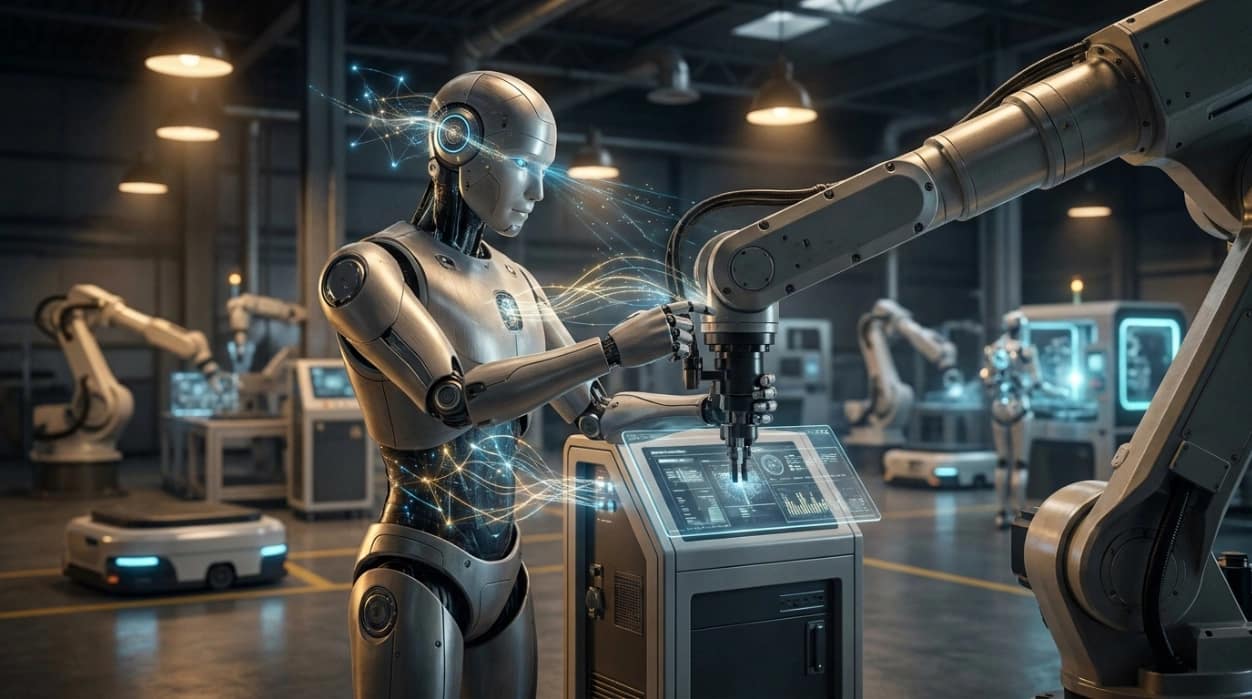
Physical AI: How Intelligent Machines Work Beyond the Screen
Artificial intelligence has spent the past few years transforming what happens inside computers.
Now something bigger may be happening.
AI is beginning to move into the physical world.
Instead of simply generating text, images or computer code, new AI systems can help robots understand their surroundings, interpret instructions and perform physical tasks.
This emerging field is known as physical AI.
The idea is attracting enormous attention because it could change how factories operate, how warehouses move products, how vehicles navigate roads and eventually how people interact with machines at home.
The technology is moving quickly.
On August 13, 2026, LG and NVIDIA announced a partnership to develop a next-generation bipedal humanoid robot built around NVIDIA’s robotics technology, with a public unveiling planned for the first quarter of 2027.
Meanwhile, Chinese robotics company Unitree has become the first humanoid robot maker in China to pursue a public listing, highlighting the growing commercial interest in the industry.
So what exactly is physical AI, and why could it become the next major technology revolution?
What Is Physical AI?
Physical AI refers to artificial intelligence that allows machines to understand and interact with the real world.
Traditional AI mostly operates inside digital environments.
For example, a chatbot can answer questions.
An image model can create a picture.
A software system can analyze thousands of documents.
A physical AI system goes one step further.
It can:
- See its environment
- Understand objects
- Interpret instructions
- Make decisions
- Move through physical spaces
- Manipulate objects
- React to unexpected situations
In simple terms:
Traditional AI thinks with information. Physical AI uses intelligence to act in the real world.
NVIDIA describes its robotics platform as providing hardware, AI models and development tools for building and deploying AI-powered robots.
This is why robotics is becoming closely connected to the broader AI revolution.
How Physical AI Is Different From Traditional Robots
Robots are not new.
Factories have used robotic arms for decades.
The difference is how those machines operate.
A traditional industrial robot may be programmed to perform the same movement thousands of times.
If the environment changes significantly, the robot may need to be reprogrammed.
Physical AI aims to make machines much more adaptable.
An intelligent robot could potentially recognize that an object has moved, understand a human instruction and change its behavior without requiring engineers to manually program every possible situation.
That is a major technological shift.
Instead of:
Instruction → fixed movement
the goal becomes:
Perception → reasoning → decision → action → feedback
This makes robots far more flexible.
Why Humanoid Robots Are Getting So Much Attention
Humanoid robots are one of the most visible applications of physical AI.
Why make a robot look like a human?
Because much of the world is already designed for humans.
Doors have handles.
Stairs are built for two legs.
Tools are designed for human hands.
Workstations are designed around human height.
A humanoid robot could potentially operate in environments that already exist without requiring companies to completely redesign them.
That doesn’t mean humanoid robots are automatically the best solution for every task.
A specialized machine may be cheaper and more efficient for a specific job.
But humanoid robots offer an interesting advantage:
They could potentially perform many different tasks using the same basic hardware.
That’s one reason companies are investing heavily in the technology.
NVIDIA Wants to Put AI Inside the Physical World
NVIDIA has become one of the biggest names in physical AI.
The company’s strategy extends beyond selling chips for data centers.
It is developing robotics platforms, simulation environments and AI models designed to help machines operate in the real world.
The latest partnership with LG provides another major example.
LG and NVIDIA are working toward a bipedal humanoid robot using NVIDIA’s Isaac GR00T foundation technology and Jetson Thor computing platform, with an unveiling targeted for Q1 2027.
This matters because it shows how the robotics industry is moving from isolated experiments toward larger technology ecosystems.
The future robot won’t simply be a machine.
It could become a combination of:
AI model + sensors + processors + robotics hardware + simulation + cloud infrastructure.
That looks increasingly similar to the modern AI stack.
Google and Other AI Companies Are Entering Robotics
The physical-AI race isn’t limited to NVIDIA.
Major technology companies are also working on AI systems designed to operate robots.
Google has been developing robotics models intended to connect AI reasoning with physical actions.
This is important because powerful language and vision models can potentially give robots a much broader understanding of instructions and environments.
Instead of programming a robot to perform one specific task, developers could eventually give it a general instruction.
For example:
“Pick up the package and place it on the loading table.”
The robot would need to identify the package, understand the table, plan a path, move its body and manipulate the object.
That requires multiple AI capabilities working together.
And that’s precisely what makes physical AI so difficult—and potentially so valuable.
China Is Moving Fast in Humanoid Robotics
China is becoming another major force in physical AI.
One of the clearest examples is Unitree.
The company became the first Chinese humanoid robot manufacturer to pursue a public listing, targeting approximately 6.1 billion yuan in fundraising. Reuters reported that Unitree generated about 1.7 billion yuan in revenue in 2025 and was already profitable. More than 40% of its sales came from overseas.
That is significant.
It suggests the humanoid robotics industry is beginning to move beyond research laboratories and into commercial competition.
Other Chinese companies are also pursuing the market, creating a rapidly developing domestic ecosystem.
This could eventually make robotics another area of technological competition between China and the United States.
Where Physical AI Could Be Used
The potential applications extend far beyond humanoid demonstrations.
Factories
Robots could move materials, inspect products, assemble components and work in environments that are difficult for humans.
Warehouses
Physical AI could help sort packages, move inventory and perform repetitive logistics tasks.
Agriculture
Machines could identify crops, remove weeds, monitor fields and perform harvesting operations.
Healthcare
Robotic systems could potentially assist with logistics, rehabilitation and certain repetitive tasks.
Construction
Robots could perform dangerous or physically demanding work while humans supervise complex operations.
Transportation
Autonomous vehicles are another form of physical intelligence because they must perceive and respond to constantly changing environments.
Homes
Eventually, household robots could perform tasks such as cleaning, organizing and handling objects.
The last category may take the longest.
Homes are much less predictable than factories.
Why Physical AI Is So Difficult
Making a robot perform a controlled demonstration is one thing.
Making it work reliably in the real world is completely different.
The physical environment is unpredictable.
A robot may encounter:
- Poor lighting
- Unexpected objects
- People moving around
- Slippery surfaces
- Different object shapes
- Damaged equipment
- Weather changes
- Unclear instructions
Humans handle these situations almost automatically.
Machines don’t.
That’s why physical AI requires enormous amounts of training data and testing.
Researchers are working on ways to improve robot learning without requiring every action to be physically tested.
One recent research approach, for example, allowed robots to plan upcoming movements while performing their current actions, significantly reducing reaction delays in experiments.
These seemingly small improvements can become extremely important when robots need to operate safely around humans.
Simulation Could Accelerate the Robotics Revolution
One of the biggest problems in robotics is collecting training data.
A software AI can potentially process millions of digital examples relatively cheaply.
A physical robot can’t.
Training a robot to pick up millions of objects would require enormous amounts of time, hardware and human supervision.
Simulation offers a solution.
Developers can create virtual environments where robots practice tasks before attempting them in the real world.
World foundation models are increasingly being explored for generating realistic simulations that can help train robots and autonomous vehicles.
This could dramatically reduce the cost of experimentation.
A robot could make thousands of mistakes inside a simulation without breaking an expensive machine.
Then the best-performing behavior could be transferred to the real world.
The Biggest Challenge May Be Cost
The technology is impressive, but price remains a major obstacle.
Companies will not deploy robots simply because they are technologically interesting.
They need to make economic sense.
A robot must provide enough value to justify:
- Hardware costs
- Software costs
- Maintenance
- Electricity
- Training
- Safety systems
- Replacement parts
- Integration with existing operations
This is why factories and warehouses are likely to adopt advanced robots before ordinary households.
Businesses can calculate the financial return more easily.
A household consumer may not be willing to spend thousands of dollars on a machine that performs only a few useful tasks.
Will Physical AI Replace Human Workers?
This is one of the biggest questions surrounding physical AI.
The answer is unlikely to be a simple yes or no.
Some repetitive jobs could increasingly be automated.
But new technology can also create new jobs.
Companies will need people who can:
- Design robots
- Train AI models
- Maintain machines
- Monitor automated systems
- Manage robot fleets
- Develop safety standards
- Integrate robotics into businesses
The bigger change may be that humans work alongside machines rather than simply being replaced by them.
A factory worker could supervise a group of robots instead of manually performing every repetitive movement.
That could make productivity much higher.
But workers will need new skills to adapt.
Why the Next Five Years Could Be Important
The next stage of physical AI may be less about spectacular demonstrations and more about deployment.
The important question won’t be:
“Can this robot walk?”
It will be:
“Can this robot reliably perform a useful job for eight hours a day?”
That is a much harder test.
Companies are increasingly moving toward real-world applications, while major technology firms are building the AI infrastructure needed to support them.
The LG-NVIDIA partnership targeting a 2027 humanoid unveiling is one recent example of how quickly the industry is moving.
If robots begin demonstrating reliable economic value, adoption could accelerate quickly.
Why Businesses Should Pay Attention
Businesses don’t necessarily need to buy humanoid robots today.
But they should understand where the technology is heading.
Industries that depend heavily on:
- Repetitive labor
- Warehousing
- Manufacturing
- Logistics
- Inspection
- Dangerous environments
could be among the first to experience major changes.
The companies that prepare early may have an advantage.
They can redesign workflows, train employees and experiment with automation before the technology becomes mainstream.
The Light Span Perspective
The first AI revolution changed how machines handle information.
The next one could change how machines interact with the physical world.
That’s what makes physical AI so important.
A chatbot can write a report.
An image model can create a picture.
But a physical AI system could eventually walk into a warehouse, understand what needs to be done and physically perform the task.
That is a fundamentally different kind of technology.
The biggest companies in AI are increasingly positioning themselves around this opportunity.
NVIDIA is building the computing and software infrastructure.
LG is preparing new humanoid hardware.
Chinese robotics companies such as Unitree are expanding commercially.
Researchers are improving how quickly robots can perceive, plan and act.
But there is still a huge gap between impressive demonstrations and reliable mass deployment.
Robots need to become cheaper, safer, faster and more adaptable.
If those problems are solved, physical AI could become one of the most important technology shifts of the next decade.
The AI revolution may have started on our screens.
Its next chapter could be walking around us.
FAQs
What is physical AI?
Physical AI is artificial intelligence designed to perceive, understand and interact with the real world through robots, autonomous vehicles and other machines.
How is physical AI different from normal AI?
Traditional AI mainly processes digital information. Physical AI combines AI with sensors, robotics and control systems so machines can physically interact with their surroundings.
Are humanoid robots physical AI?
Yes. Humanoid robots can be considered an important application of physical AI when they use AI systems to perceive their surroundings, make decisions and perform physical actions.
Who is developing physical AI?
Companies including NVIDIA, Google, LG and numerous robotics startups are developing technologies related to physical AI. Chinese robotics companies are also becoming increasingly important in the sector.
Will physical AI replace human workers?
It may automate some repetitive or dangerous tasks, but it is also likely to create new roles involving robot development, supervision, maintenance and AI management.
When will physical AI become mainstream?
There is no reliable date. Industrial applications are likely to scale before general-purpose household robots because factories and warehouses provide more controlled environments.
Why are humanoid robots important?
Humanoid robots can potentially operate in environments already designed for humans, including factories, warehouses and homes. Their general-purpose design could eventually allow one machine to perform multiple tasks.
What is the biggest obstacle to physical AI?
Reliability, safety and cost remain major challenges. A robot must perform useful tasks consistently in unpredictable environments before mass adoption becomes practical.
Continue reading more

